This is Part 2 of an AI visibility test for a client, Alternatives.pe, a private market data platform. Get the full context in this post.
In summary: We redesigned the website, optimised it for SEO and GEO with Phase 1 of our content strategy, so I wanted to see how it fared in terms of AI visibility. It performed well on Gemini and Perplexity, but visibility on ChatGPT and Claude lagged behind. Naturally, I had to investigate why.
I set up an experiment to prompt both ChatGPT and Claude on various aspects of my client’s business, and here’s what I found.
When asked directly about the company, both models could answer well. They described the business accurately, understood the product focus, and correctly answered follow-up questions about specific capabilities.
So both ChatGPT and Claude were aware of us. They could discover and understand the brand just fine.
But when asked a broad question like, “What’s the best private market database in Southeast Asia?”, neither cited us in its response.
When I asked it to solve a customer’s problem, “Where can I find cap table data for startups in Asia?”, neither cited us either.
Interestingly, when I added a direct follow-up (“does Alternatives.pe provide cap table data?”), both ChatGPT and Claude came back with a confident and accurate yes, and updated their responses to include the brand as a strong contender.
What this told me is that AI tools like ChatGPT and Claude treat discovery, relevance and selection very differently from pure search.
In this case, discovery wasn’t a problem. But the association between the brand and category, or brand and use case, hadn’t been sufficiently established for the AI to recommend it objectively.
Different dimensions of AI visibility
This led me to break AI visibility down into several different stages, rather than treating it as a single yes/no metric:
- Identity: Can the AI find your brand?
- Entity recognition: Does it understand what the company is, who it serves, and where it operates?
- Capability recognition: Does it understand the products, features, and types of data the company provides?
- Relevance: When a user describes a problem without naming the company, does AI connect that problem to the brand?
- Selection: When several providers could plausibly solve the problem, does AI actually recommend the brand?
- Intent alignment: Does it understand the underlying job the customer is trying to accomplish, rather than simply matching a keyword or product feature?
The gap appeared when ChatGPT and Claude had to establish relevance on its own. The models weren’t consistently making the leap from “this is what the Brand does” to “this is when you’d reach for this Brand”.
We passed the first three tests surprisingly well. Both AI models could find the brand when explicitly asked, describe what it does and confirm specific capabilities when asked.
That distinction matters because it changes what we should optimise for. Now it isn’t just about making a model aware that your company exists, you also have to build enough understanding and evidence that it connects your company to the situations where a customer would actually need it.
So what did this mean for our content strategy?
Instead of more pages describing the product, we need content that explicitly connects a customer’s problem to the capability that solves it. It needs to spell out the “when you’d reach for this” instead of leaving the model to infer it.
For a data provider, that could mean making un-gating selected data, publishing commentary or analysis framed around specific use cases (E.g. How to find cap table data for Asia startups) rather than gating everything behind a paywall.
For a SaaS product, it could mean documentation that ties a workflow or integration to the exact problem it resolves, not just how the feature works.
What a full GEO strategy actually requires
Picture two companies.
Company A has a hundred pages on its own site saying, “we are a leading brand in this category”.
Company B has fewer owned pages, but is independently described the same way by industry publications, analysts, and comparison sites.
Those two companies can look identical on their own websites, but the difference is in how much independent evidence exists to back the claim up. You can bet Company B is more likely to be recommended and cited by AI.
An AI model’s knowledge of a brand is built from the wider body of information available about it, not just what the brand says about itself on its own domain. It’s independent evidence that lets the model know why it should believe the claims.
A full GEO or AI visibility strategy is a full-funnel content strategy + independent authority. The relevance gap I found in my own test (Brand being understood but not connected to the customer’s problem) turns out to be one piece of a bigger picture.
Here’s what I think a full strategy looks like:
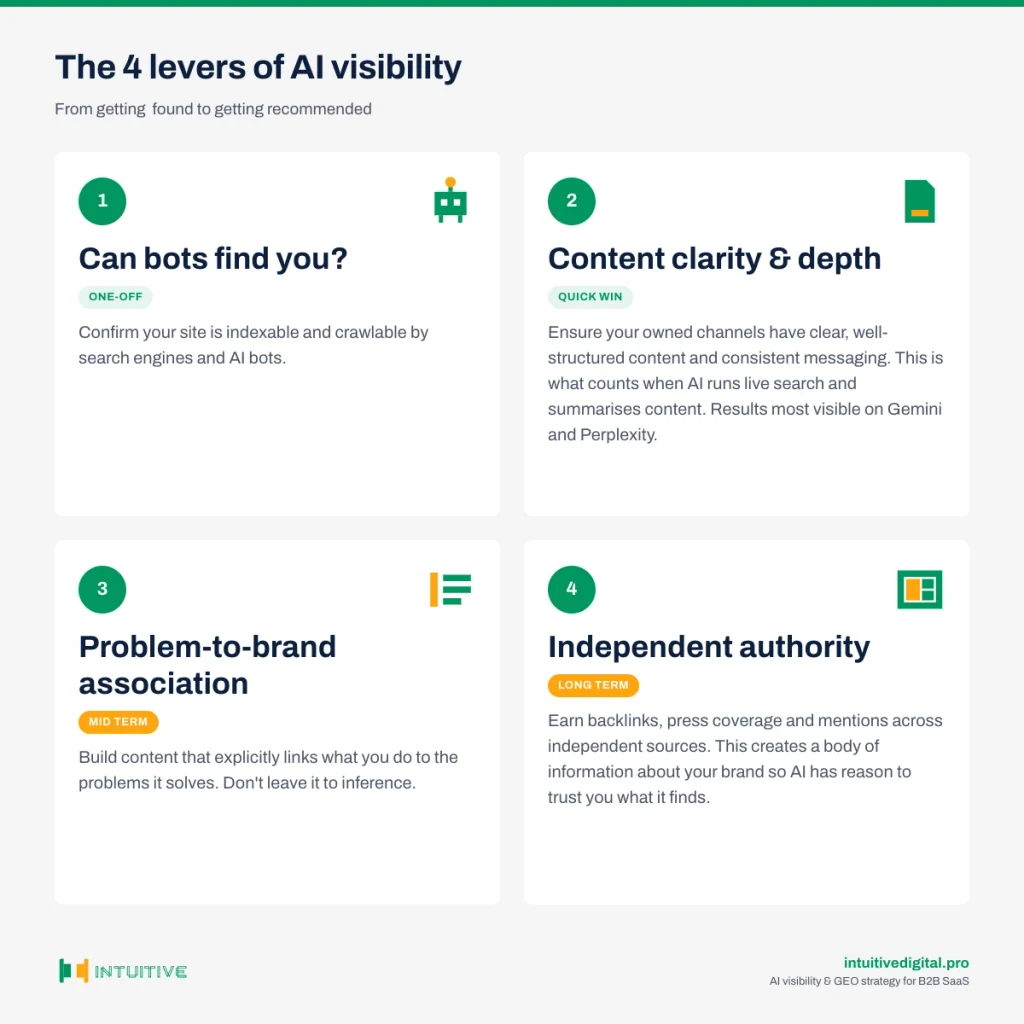
- Can bots find you? (one-off): Confirm that your site can be indexed and crawled by the relevant bots (search and AI).
- Content clarity & depth (short term): Ensure your owned channels have clear and consistent messaging for live searches. Perplexity and Gemini reward the same fundamentals SEO always has, well-structured content will help you here.
- Problem-to-brand association (mid term): Make the link between what you do and the problems it solves explicit. Don’t assume that a model will infer it the way a human would after a moment’s thought.
- Independent authority (long term): Backlinks, press coverage, comparison content, and being discussed across independent sources, so there’s more of you to find and more reason to trust what it finds.
More product pages won’t fix a missing customer-intent association.
More backlinks won’t substitute for content that actually explains a complex product.
And strong owned content doesn’t automatically create independent authority.
A real GEO strategy is building a coherent, explicit knowledge graph around the brand: what it is, what it knows, who it’s for, and why it should be trusted.
If you want to get your company or brand recommended by AI and search engines, let’s talk.