Traditional SEO tells you where you rank on Google. It tells you nothing about whether ChatGPT, Perplexity, Gemini, or Claude actually mention your brand when someone asks a relevant question.
G2’s 2026 Buyer Behavior Report found 51% of B2B software buyers now start their purchase research in AI chat rather than a traditional search engine, up from just 29% about a year earlier. As more research moves inside an AI chat window instead of a search bar, getting visibility in the form of AI citations or recommendation can’t be ignored.
I decided to actually run an AI visibility test for one of my clients (a private markets data platform for Southeast Asia and Australia), for which I had launched a redesigned and SEO-optimised website.
The setup
I picked 8 prompts across four categories that map to how our actual buyers search:
- Category/discovery: Broad question, no brand named (“What’s the best private markets data platform for Southeast Asia?”)
- Comparison: Tests share of voice against named competitors (“Alternatives to [Competitor #1 ] for tracking Australian private company deals”)
- Use-case specific: Matches real workflows the buyer needs done (“How can a PE firm find buyout targets in Asia?”)
- Feature specific: Tests whether our actual differentiators surface (“What platforms show fund performance metrics like Net IRR and DPI?”)
Each prompt ran 3 times across 4 engines (ChatGPT, Gemini, Perplexity, and Claude) for 96 total data points. Each run happened in a fresh, memory-free session (incognito or logged-out where possible), to approximate a prospective customer encountering the brand cold.
I logged three things per run: whether we were cited (Y/N), which page got cited, and where we ranked in the list, if mentioned.
Here’s what I found
- 32% overall citation rate across all 96 runs, citing top level pages of our recently overhauled website.
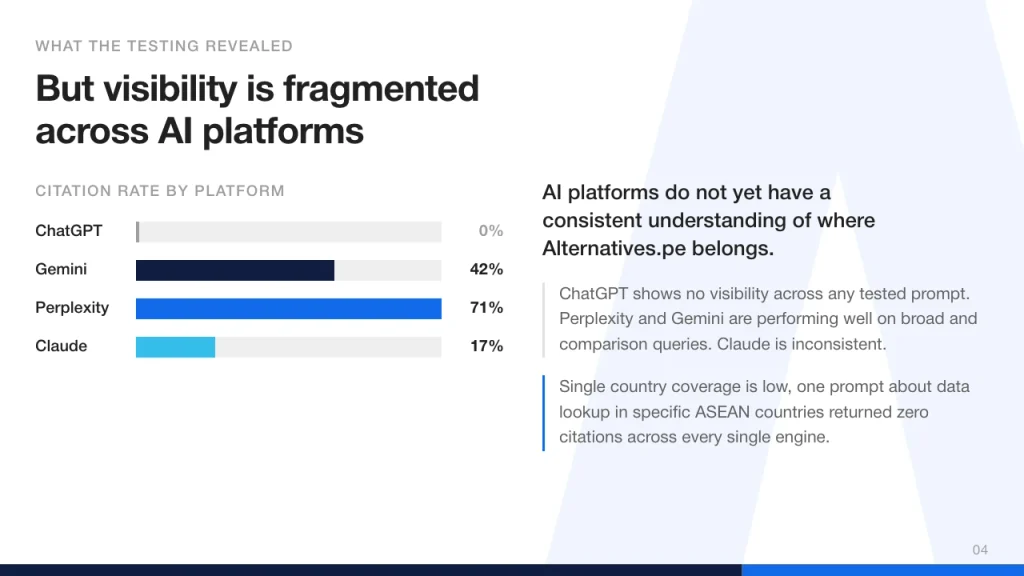
- We showed up in 71% of Perplexity runs, 42% of Gemini runs, 17% of Claude runs, and 0% of ChatGPT runs. The spread was significant, here’s where I dissect it: Part 2.
- We also performed best for prompts related to top funnel discovery, followed by comparison. For use case and feature specific prompts, we were only picked up by Perplexity.
- Out of the discovery category, we performed well on prompts related to regional coverage. But received zero citations when it came to queries relating to individual countries.
How our content strategy influenced AI citation
1. Clarity and consistency of messaging matters a lot
Prompts related to regional discovery worked well. For example, “Best private markets platform for Southeast Asia” hit 9 of 12 runs – our strongest result. That maps to clear positioning on the website for regional geographical coverage.
But the moment we swap in a more specific version of the exact same intent (“private company data in Indonesia, Vietnam, and the Philippines”), citations dropped to 0 of 12. Content on individual country expertise hadn’t been shipped yet, and it shows. The same intent, narrowed to a specific market, dropped to zero. There’s nothing at that depth for a model to retrieve or connect to a highly specific query.
2. Highly-specific product pages give AI evidence to cite
Most citations pointed to the website’s homepage or product pages. It did not cite our use case pages, which were written to be more outcome-focused for the audience, rather than feature-focused.
What I took from this as a marketer is that we’re communicating to two audiences. The human buyer (where outcome-focused copy tends to resonate better) and AI models that need specific product evidence, so it can decide whether a product credibly earns its place in its AI response. In simple terms, brands need to articulate (1) the problem they help customers solve and (2) how they solve it.
3. More use-case and query-mirroring content is required
It was clear that we were cited well in areas we invested content in. In our case (a data provider), the content skews heavily toward the type of data the product makes available, but less on how to use it in a customer’s workflow. Content that relates to actual client use cases was thin and is something that should be prioritised, as this closely mirrors the questions potential buyers would ask an AI tool.
4. Not all AI tools behave the same
We performed best on Perplexity (71%) and Gemini (42%), probably because both those engines run live search queries for each prompt. The fact that the site is SEO optimised and ranks well on Google gives it a natural edge for Gemini and Perplexity. Perplexity was also more likely to cite our LinkedIn content, which is more surface for owned channels.
However, we performed inconsistently on Claude (17%) and were virtually invisible on ChatGPT. I dive into that in the next post. But in short, it has to do with how the two platforms rely mainly on training data, which has a cut off date, and only run occasional live queries based on user prompts. They also place higher weightage on third party citations from credible sources, rather than solely on owned channels or first-party information.
So, it is possible to rank highly on Google and be invisible on ChatGPT.
SEO and AI visibility aren’t the same problem
It’s tempting to treat AI SEO as classic SEO with a new set of crawlers to allow in robots.txt. But this test made it clear that it’s more than that.
Good SEO ensures your brand is discovered by people or AI crawlers alike. But it doesn’t get you recommended by AI. There’s a gap between product information and market authority. A brand website tells an AI model what you do, but not yet why it should treat us as a credible source on the subject.
In Part 2, I dive deeper into the difference in getting found by ChatGPT and Claude versus getting recommended, and what it takes to get there.