
This guide walks you through building a keyword strategy designed for freight buyers so you can show up earlier in search, influence decisions, and drive more qualified demo-ready traffic.
Here’s a step-by-step guide to building a keyword strategy that attracts the right logistics-tech buyers.
Step 1: Shortlist keyword ideas based on buyer context
If you start with broad, vague terms and high volume keywords like ‘supply chain visibility’ or ‘transportation management system’, you’d likely be chasing irrelevant clicks. Simply because a ‘Transportation Management System’ could mean one thing to A but something else completely different to B.
Instead, look at it from your buyer’s perspective. What are the pain points they need to solve? How do they phrase the solutions they are looking for? And how does your product meet that need?
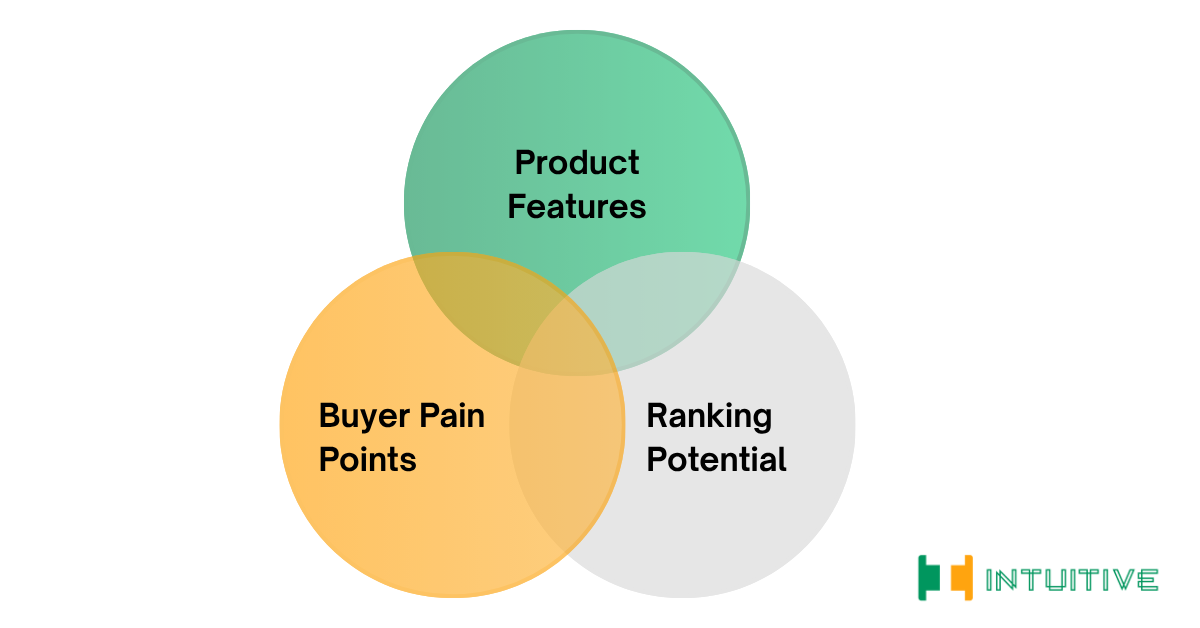
Product Features
Most of us clearly know to start with Product Features and what differentiates your product. For example, if you’re a Warehouse Management System, then your product offering ‘Carrier On-Time Scorecards’ would make it to your keyword list.
Buyer Pain Points
This is another dimension we’re familiar with: the problems that your buyers are trying to fix. They may be aware of solutions that exist in the market, but other times they may be just looking for a better way to do something. Keywords could be: customs paperwork automation, tracking integration with ERP, or reducing demurrage charges.
RFP Language
This last one is a gold mine: look at actual tenders and highlight recurring phrases. It gives you insight into how your procurement teams phrase and search for solutions. They’ve already done their research online and carefully selected
E.g. multi-carrier booking, container visibility API.
With this, you can shortlist 10–15 seed topics that overlap your product strengths with buyer intent to feed into your keyword strategy.
Step 2: Expand with Keyword Ideas
Once you have your shortlist of seed topics, you can use various SEO tools to uncover how buyers actually phrase their searches. Along with keyword suggestions, you’ll also get search volumes, keyword difficulty and cost per paid click (CPC) data, which tells you how much people bid for those keywords. Export everything into a spreadsheet so you can prioritise your keywords.
Remember, since you’re going for niche keywords, it’s natural for search volume to be lower but intent will be higher.
Here are some of the commonly used SEO tools:
- Ahrefs / SEMrush: These are comprehensive SEO tools that help with keyword ideas. You can paste the seed topic, filter by individual countries and export keyword suggestions.
- Google Keyword Planner: This is good for estimating search volume and CPC.
- Ubersuggest / AnswerThePublic: These provide a quick check for question-type searches (“how to evaluate WMS vendor”). Ubersuggest is also a low cost SEO tool for small businesses.
Step 3: Score and Prioritise Keywords
At this stage, you’ll have a messy list of 100–300 keywords from Ahrefs or SEMrush. The temptation is to chase the ones with the biggest search volume, but resist that.
In logistics tech, quality beats quantity because one keyword that brings a procurement manager is worth more than 1,000 clicks from students or job seekers.
To prioritise keywords, score them from 1 -3 along three criteria: Business Fit, Buyer Intent and Ranking Potential.
Business Fit
Does this keyword tie directly to your solution or an RFP line item? For example, if this lines up with what your product does, then “WMS integration with SAP Singapore” is a good keyword for you.
An example of a weak keyword would be something broad like, “logistics technology trends” as it’s less likely to bring demo-ready leads.
Buyer Intent
What is the searcher really trying to do? You can infer the buyer’s intent from the nature of their search queries and categorise them accordingly.
- Informational: These searches indicate early awareness where buyers are researching a problem, e.g “what is freight visibility”.
- Consideration: At this stage, buyers are shortlisting and comparing solutions. It is crucial for your product to be visible at this stage. An example of keyword would be “freight visibility software vendors”
- Decision: Buyers are ready to make a decision and are likely to be a hot lead at this stage. Search queries would look like “freight visibility platform demo Singapore”
Ranking Potential
Can you realistically rank for this keyword? Look at Keyword Difficulty (KD), it’s a numeric estimate of how hard it will be to rank. If you’re just starting out, a KD of 10–20 is a good place to start. You can tackle keywords of KD more than 70 when your domain authority has improved.
Apart from Keyword Difficulty, you also want to look at the Search Engine Results Page (SERP) on Google.
Avoid if the SERP is dominated by global media or .gov sites
If every top result is from Gartner, TechCrunch, SupplyChainDive, or government portals (.gov, .org), you’re competing with sites that have thousands of backlinks and massive domain authority. It makes for a poor investment of time for a niche SaaS.
It’s a good sign, if page one is full of thin vendor blogs, weak directories, Quora/Reddit answers, or old PDFs
These results mean Google doesn’t have authoritative content yet. By publishing something deeper and more buyer-relevant, you can win quickly.

Step 4: Cluster and Map to Content
Instead of creating random blog posts, group your keywords into clusters. Each cluster is one buying theme (like WMS, freight visibility, or customs automation).
Decide on a Pillar page. This would be a broad keyword that’s evergreen and covers the theme at a high level, say “Cross-Border WMS for Southeast Asia”.
Next, create supporting posts, these are pages with a narrower focus that answer specific searches. For example:
- “Top Customs Automation Vendors in SEA”
- “How to Integrate WMS with SAP in Singapore”
- “On-Time Delivery Benchmarks for Cross-Border Freight”
Every supporting post should link back to the pillar page. Over time, this signals to Google that you’re the authority on the topic.
Step 5: Match Content & CTA to Buyer Stage
Not every keyword deserves the same kind of page. Match content and the call to action (CTA) to where the buyer is in their journey, so each piece of content does its job to educate, influence, or convert.
- For awareness keywords (e.g. “what is freight visibility”), you can write an explainer blog or create an infographic with the call to action to subscribe or learn more.
- For consideration keywords (e.g. “best freight visibility software SEA”), you can publish comparison guides, benchmarks, or RFP templates. These would have a call to action to download.
- For decision keywords (e.g. “freight visibility platform demo Singapore”), optimise your product pages, case studies and demo forms, with strong call to action to book a demo.
Step 6: Review, Refresh, and Expand Quarterly
In logistics tech, new tenders and new lanes appear constantly. Schedule a quarterly review to add fresh RFP language you’re seeing or refresh posts with updated data. You can also test new content clusters to stay up-to-date with industry trends, e.g. sustainability metrics, carbon reporting.
Building a Keyword Strategy for Logistics Tech SaaS
A keyword strategy for logistics tech isn’t about chasing the highest-volume terms, it’s about speaking the language of procurement and operations buyers. By anchoring your research in RFP line items, pain points and integration needs, you uncover keywords that may not have huge search numbers but signal real commercial intent.
By following this strategy, your SEO stops being about vanity traffic. It becomes a pipeline engine that gets your platform into the shortlist before an RFP even lands on your sales team’s desk.
If you’d like an extra set of eyes on your own keyword landscape, Intuitive Digital specialises in pipeline-driven SEO for logistics tech. We offer a free 7-day SEO audit so you can see where the opportunities are in your market.