The LLM Citation Landscape: What the Data Shows
Ahrefs recently analyzed the most-cited domains across three leading AI tools: ChatGPT, Perplexity, and Google’s AI Overviews. The findings are eye-opening. For example, Wikipedia is the most frequently cited domain by ChatGPT, taking up 16.3% of total citations. YouTube dominates citations on Perplexity (16.1%), while Google’s AI Overviews lean heavily on Reddit and Quora, which don’t even appear in ChatGPT’s top 10. This data suggests that different AI tools rely on different types of content and sources. For example, ChatGPT favours structured, high-authority content that is rich in context and relevance. But Google AI prioritise user-generated content.Why Getting Mentioned by AI Matters
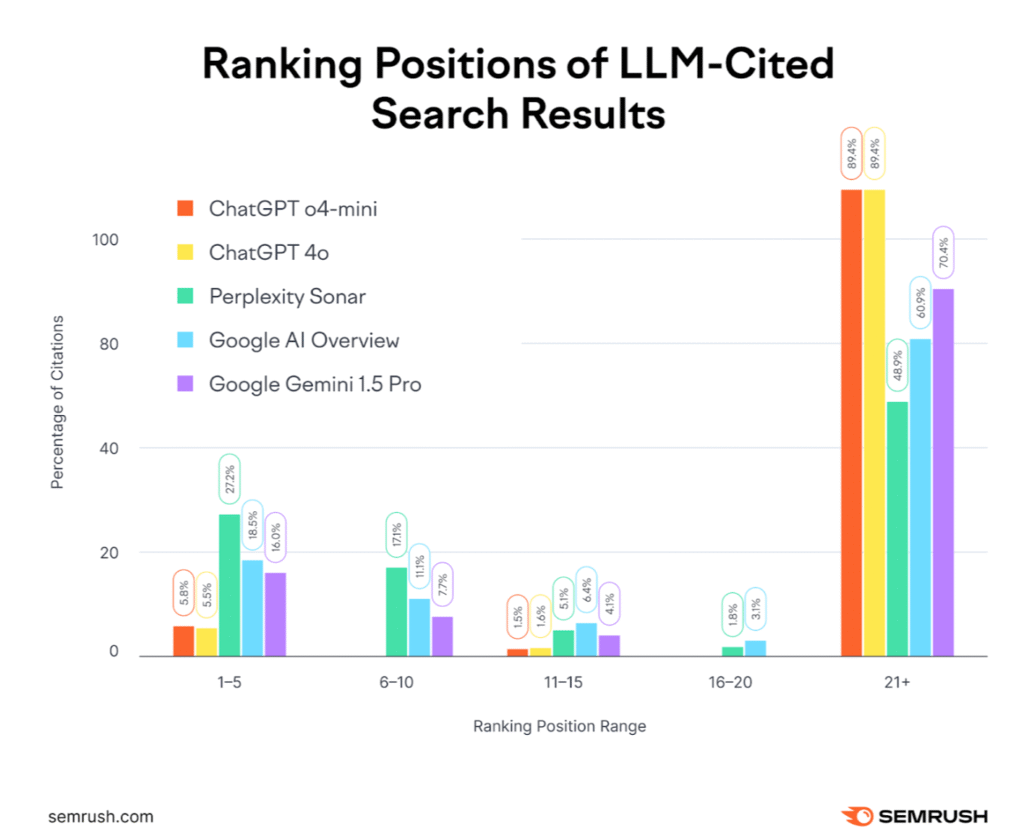
The way people search is evolving. Tools like ChatGPT and Perplexity are no longer niche utilities — they are becoming primary gateways for research, product discovery, and decision-making. In many cases, AI tools don’t just point users to a list of links; they generate summaries and recommendations that skip over traditional web listings entirely. If your brand isn’t cited in these responses, you may not even enter the consideration set. While a typical user is expected to click on fewer search listings, SEMrush reports that the average AI search visitor is 4.4 times as valuable as the average visit from traditional organic search, based on conversion rate. Because they are equipped with the information to make a decision. This is why it’s important to get visibility in LLMsHow to Get Mentioned by AI: Lessons from the Data
So what makes content “citation-worthy” in the eyes of an LLM? Based on the patterns from Ahrefs and Semrush, here are a few key principles:1. Create authoritative, structured content
Tools like ChatGPT favour structured explainers, how-tos, and in-depth breakdowns that educate humans and LLMs. That’s why Wikipedia dominates. Think of becoming an authority in your area of expertise. Provide content that’s grounded in factual clarity, rich in context and is highly specific — making it ideal fodder for AI tools to surface in their responses.2. Make use of video and transcripts
YouTube is the #1 cited domain on Perplexity. But it’s not just video that matters — it’s the transcripts. AI models scrape transcript data to summarize content. If you’re producing video content, make sure transcripts are available and accessible. Explainer videos, founder POVs, or product walkthroughs that answer clear questions are especially valuable.3. Get mentioned on UGC platforms
Reddit and Quora were among the most cited sources in Google AI Overviews. Unlike the usual SEO marketing content, these mentions are user-generated and come from discussion threads. This tells us that brand visibility in UGC communities is increasingly influential. Being part of conversations on Reddit, answering questions on Quora, or earning organic brand mentions from others can help get your brand picked up by Google’s AI summaries.4. Prioritise clarity, not just keywords
From Search Engine to Answer Engine
AI has begun to reshape how information is found and presented. Instead of delivering a list of 10 blue links, AI search tools aim to provide a confident, summarized response. That means fewer clicks, fewer impressions, and fewer chances to get in front of buyers — unless your content is being cited directly. Whether you run a startup or a scaled B2B SaaS company, your growth depends on being in the conversation. Not just among peers, but among the AI tools shaping how people find and evaluate solutions. If you want to future-proof your visibility, your marketing strategy needs to account for this shift. Don’t just optimize for search. Optimize for citation.Download: AI SEO Cheat Sheet
Want a quick-reference version of the key domains cited by AI tools and what it means for your strategy?Download our 1-page visual summary